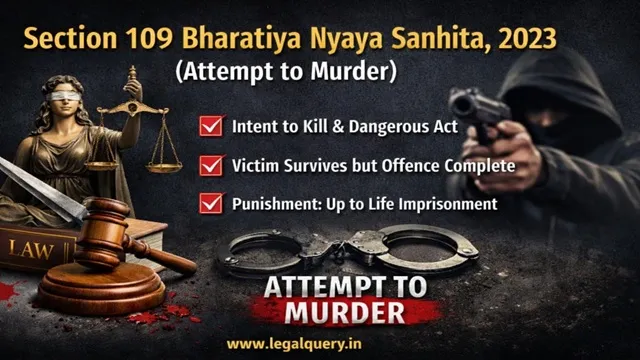
If someone tried to kill you or a family member but the victim survived, or if you have been accused of attempting to murder, this article will explain everything you need to know about Section 109 of the Bharatiya Nyaya Sanhita, 2023 (BNS) in plain and simple language.
Section 109 BNS deals with the offence of attempt to murder. It covers situations where a person, with a clear intention or knowledge that their act could cause death, takes a direct step towards committing murder, but the victim survives. Under this law, actual death is not required. If the intention was to kill and a life-threatening act was committed, the offence is complete the moment that act is performed.
This law came into force on 1st July 2024 as part of the Bharatiya Nyaya Sanhita, 2023, which was published in the Official Gazette of India by the Ministry of Law and Justice on 25th December 2023. It replaced the earlier Section 307 of the Indian Penal Code, 1860.
Which Chapter Does Section 109 BNS Belong To?
Section 109 BNS falls under Chapter VI of Offences Affecting the Human Body of the Bharatiya Nyaya Sanhita, 2023. This is the chapter that deals with the most serious crimes against a person's life and physical safety, including murder and culpable homicide.
Exact Legal Text of Section 109 BNS, 2023
The following is the exact text of Section 109 as published in the Official Gazette (No. 45 of 2023) by the Ministry of Home Affairs, Government of India:
Sub-section (1): Whoever does any act with such intention or knowledge, and under such circumstances that, if he by that act caused death, he would be guilty of murder, shall be punished with imprisonment of either description for a term which may extend to ten years, and shall also be liable to fine; and if hurt is caused to any person by such act, the offender shall be liable either to imprisonment for life, or to such punishment as is hereinbefore mentioned.
Sub-section (2): When any person offending under sub-section (1) is under sentence of imprisonment for life, he may, if hurt is caused, be punished with death or with imprisonment for life, which shall mean the remainder of that person's natural life.
Source: The Bharatiya Nyaya Sanhita, 2023 No. 45 of 2023, published in the Official Gazette of India on 25th December 2023 by the Ministry of Home Affairs, Government of India.
Official document available at: https://www.mha.gov.in
Official Illustrations Given in Section 109 BNS
The following illustrations are part of the official text of Section 109 BNS, 2023, as published in the Official Gazette:
- Illustration (a): A shoots at Z with the intention to kill him, under such circumstances that, if death ensued, A would be guilty of murder. A is liable under this section even if Z is not killed.
- Illustration (b): A, with the intention of causing the death of a child of tender years, exposes it in a desert place. A has committed the offence defined by this section, though the death of the child does not ensue.
- Illustration (c): A, intending to murder Z, buys a gun and loads it. A has not yet committed the offence. But if A fires the gun at Z, the offence is now complete. If Z is wounded by the firing, A is liable to the more severe punishment provided in the section.
- Illustration (d): A, intending to murder Z by poison, purchases poison and mixes it with food which remains in A's keeping. A has not yet committed the offence. But when A places the food on Z's table or delivers it to Z's servants to place it on Z's table, A has committed the offence defined in this section.
What these illustrations teach us: The law draws a clear line between preparation and attempt. Preparation alone, buying a weapon, mixing poison while it is still in your possession, is not punishable under this section. The offence is complete only when a direct step of execution is taken, such as firing the gun or placing the poison before the victim.
Essential Ingredients of Section 109 BNS
For a court to convict a person under Section 109 BNS, all of the following legal ingredients must be established by the prosecution:
- Intention or Knowledge: The accused must have intended to cause death, or must have acted with the knowledge that the act was likely to cause death. This mental element, called mens rea, is the most important ingredient. Without it, the offence under this section cannot be established.
- An Overt Act Beyond Preparation: There must be a direct and concrete step taken towards committing murder. Planning and buying weapons is only preparation. The accused must have actually executed or attempted to execute an act that could cause death.
- The Act Must Be Such That Had Death Resulted, It Would Amount to Murder: The act must satisfy the test for murder under Section 101/103 BNS, meaning that had death resulted, the accused would have been guilty of murder, not merely culpable homicide not amounting to murder.
- Death Did Not Occur: The victim survived. If death had occurred, the charge would have been murder, not attempt to murder.
- Hurt May or May Not Have Been Caused: Even if the victim was not physically injured at all, the offence is still complete if the above ingredients are present. However, whether or not the hurt was caused directly determines the severity of the punishment.
Preparation vs Attempt: The Critical Legal Distinction
One of the most frequently argued questions in attempted murder cases is: when does preparation end and attempt begin? This distinction is directly addressed in the official illustrations of Section 109 BNS itself.
Only Preparation Not Punishable Under Section 109 BNS:
- Buying a gun and loading it (as per Illustration c of Section 109 BNS)
- Purchasing poison and mixing it with food that is still in your own possession (as per Illustration d of Section 109 BNS)
Attempt Punishable Under Section 109 BNS:
- Firing the gun at the intended victim (Illustration c)
- Placing poisoned food on the victim's table or delivering it to the victim's servants (Illustration d)
- Shooting at someone with the intent to kill, even if the shot misses (Illustration a)
- Abandoning a child in a dangerous, deserted place with the intent that the child dies (Illustration b)
In simple terms, the moment the accused loses control over whether harm reaches the victim or not, preparation has turned into an attempt.
Punishment Under Section 109 BNS Complete Table
| Situation | Punishment | Nature of Offence | Triable By |
|---|---|---|---|
| Attempt to murder, no hurt caused to the victim | Imprisonment of either description (simple or rigorous) for a term up to 10 years, and a fine | Cognizable, Non-bailable | Court of Session |
| An attempt to murder hurt is caused to the victim | Imprisonment for life, OR imprisonment up to 10 years and a fine | Cognizable, Non-bailable | Court of Session |
| The offender is already serving life imprisonment and causes hurt while attempting murder | Death, OR imprisonment for life, meaning the remainder of that person's natural life | Cognizable, Non-bailable | Court of Session |
Important Clarification on "Life Imprisonment" Under Section 109 BNS
Section 109(2) BNS explicitly states that where a person already serving life imprisonment commits an attempt to murder and causes hurt, the life imprisonment imposed as punishment shall mean the remainder of that person's natural life. This is a significant and deliberate clarification made in the Bharatiya Nyaya Sanhita, 2023 by the legislature.
Section 109 BNS vs Section 307 IPC Key Differences
| Point of Comparison | Section 307 IPC, 1860 (Old Law) | Section 109 BNS, 2023 (New Law) |
|---|---|---|
| Parent Law | Indian Penal Code, 1860 | Bharatiya Nyaya Sanhita, 2023 |
| Effective From | 1860 repealed on 1st July 2024 | 1st July, 2024 |
| Core Offence | Attempt to murder | Attempt to murder |
| Basic Punishment (no hurt) | Up to 10 years and fine | Up to 10 years and fine same |
| Punishment When Hurt Is Caused | Life imprisonment or up to 10 years and fine | Same |
| Meaning of Life Imprisonment Explicitly Defined? | No caused varying interpretations | Yes explicitly means the remainder of natural life |
| Punishment for Life Convicts Who Cause Hurt | Death or imprisonment for life | Death or life imprisonment for the remainder of natural life |
| Language | Colonial-era English | Modern, updated legal language |
The structure and punishment under Section 109 BNS and Section 307 IPC are largely identical. The most significant improvement in BNS is the explicit clarification that life imprisonment means imprisonment for the remainder of the person's natural life removing the ambiguity that existed under the IPC.
Nature of the Offence Under Section 109 BNS
Cognizable Offence
Section 109 BNS is a cognizable offence. This means the police have the legal authority to arrest the accused without obtaining a warrant from a Magistrate first. The police can also begin an investigation without prior permission from the court. If you learn that an FIR has been registered against you under this section, you must act immediately and seek legal advice.
Non-Bailable Offence
This is a non-bailable offence. Bail is not a right; it is a discretion of the court. The accused cannot demand bail from the police. They must apply to the Sessions Court or the High Court, which will decide whether bail should be granted based on the facts, circumstances, seriousness of the allegation, and other relevant factors.
Triable by the Court of Session
This offence is exclusively triable by the Court of Session. A Magistrate does not have the power to try this case on its merits. The case may be committed to the Sessions Court by the Magistrate after initial proceedings.
What to Do If You Are a Victim of an Attempt to Murder
If you or someone close to you has survived a murder attempt, here are the steps to take immediately:
- Seek medical help first. Go to the nearest government hospital. The doctor's examination and treatment record becomes a medico-legal report this is one of the most important pieces of evidence in court.
- File an FIR at the nearest police station. Since this is a cognizable offence, the police are legally bound to register an FIR and investigate. If you are hospitalised, a family member or friend can file the FIR on your behalf. The police cannot refuse to register an FIR in a cognizable offence case.
- Preserve all evidence. Keep the clothes worn during the attack. Do not disturb the scene. Note down the names and contact details of any witnesses.
- Obtain a free copy of the FIR. Under the Bharatiya Nagarik Suraksha Sanhita, 2023, you are entitled to receive a free copy of the FIR.
- Consult a criminal lawyer. A qualified lawyer will ensure the correct sections are applied, the investigation is conducted properly, and your rights as a victim are protected throughout the trial.
What to Do If You Are Falsely Accused Under Section 109 BNS
False accusations under serious criminal sections do occur in India, particularly in cases arising from property disputes, family conflicts, or personal enmity. If you are falsely accused:
- Do not flee or abscond. Running away can be treated by the court as evidence suggesting guilt.
- Apply for anticipatory bail immediately before the Sessions Court or High Court under the Bharatiya Nagarik Suraksha Sanhita, 2023, before you are actually arrested.
- Collect all evidence that supports your innocence, such as CCTV footage, call records, witness statements, or any document proving your location at the time of the alleged incident.
- Engage a criminal defence lawyer without delay. Do not wait until after the arrest. Act from the moment you know an FIR is being registered or is likely to be registered.
Section 109 BNS and Common Intention
When two or more persons together commit an act of attempt to murder in furtherance of a common intention, each one of them can be held equally liable under Section 109 BNS read with Section 3(5) of the Bharatiya Nyaya Sanhita, 2023. This applies even if only one person among the group physically carried out the act. The law treats every participant in a common plan as equally responsible.
Official Government Sources
- Bharatiya Nyaya Sanhita, 2023.
- New Criminal Laws - Ministry of Home Affairs: https://www.mha.gov.in/en/commoncontent/new-criminal-laws
FAQ's
Section 109 of the Bharatiya Nyaya Sanhita, 2023 is the law that punishes attempt to murder where a person tries to kill someone with intention or knowledge but the victim survives. It replaced Section 307 of the Indian Penal Code, 1860, with effect from 1st July 2024.
No. Even if the victim survives completely without any injury, the offence is complete as long as the accused had the intention to kill and committed a direct act towards it.
If no hurt is caused imprisonment up to 10 years and fine. If hurt is caused life imprisonment or imprisonment up to 10 years and fine. If the offender is already serving a life sentence and causes hurt death or life imprisonment for the remainder of natural life.
The offence and punishments are largely identical. The key improvement in BNS is that life imprisonment is now explicitly defined as imprisonment for the remainder of the person's natural life. The term "transportation for life" from IPC has also been replaced with clearer modern language.
It is a non-bailable offence. Bail is not a matter of right. The accused must apply to the Sessions Court or the High Court for bail.
Yes. It is a cognizable offence. The police can arrest the accused without a prior warrant from a Magistrate.
The Court of Session (Sessions Court). A Magistrate cannot try this case on merits.
Preparation such as buying a weapon or mixing poison while it is still in your possession, is not punishable under Section 109 BNS. The offence becomes complete only when a direct act of execution is performed, such as firing at the victim or placing poison before them. This distinction is clearly illustrated in the official text of Section 109 BNS itself.
Yes. If no harm is caused, the maximum punishment is 10 years. If hurt is caused, the court can impose life imprisonment.
Yes. If you apprehend arrest, you can apply for anticipatory bail before the Sessions Court or the High Court under the provisions of the Bharatiya Nagarik Suraksha Sanhita, 2023.
Yes. Under Section 3(5) BNS, where two or more persons act in furtherance of a common intention to commit murder, each of them is equally liable even if only one person physically performed the act.
Under Section 109(2) BNS, if a person who is already serving a life sentence commits attempt to murder and causes hurt, the court can impose death or imprisonment for life meaning the remainder of that person's natural life.
The accused must have either the intention to cause death, or the knowledge that the act is likely to cause death. Without this mental element, the charge under Section 109 BNS cannot be sustained.
Section 109 BNS came into force on 1st July 2024, the date on which the entire Bharatiya Nyaya Sanhita, 2023 was brought into effect by the Central Government.
Section 109 BNS came into force on 1st July 2024, the date on which the entire Bharatiya Nyaya Sanhita, 2023 was brought into effect by the Central Government.
The complete and official text of the Bharatiya Nyaya Sanhita, 2023 is available on the Ministry of Home Affairs website at https://www.mha.gov.in/sites/default/files/250883_english_01042024.pdf
Add new comment