Introduction
- India's rural employment landscape has changed significantly since the introduction of MGNREGA (Mahatma Gandhi National Rural Employment Guarantee Act) in 2005.
- Over the past two decades, rural incomes have risen, poverty has declined, and the expectations from public employment programmes have evolved.
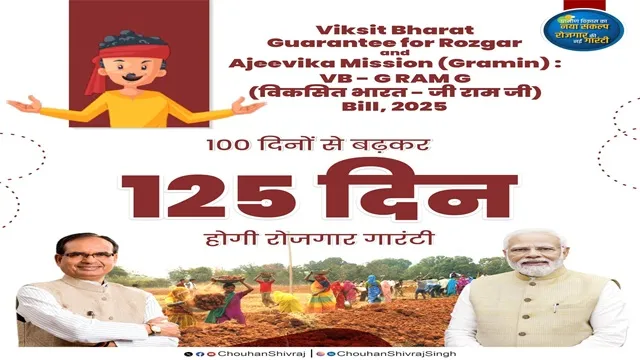
- In this context, the Viksit Bharat - Guarantee for Rozgar and Ajeevika Mission (Gramin), enacted under the VB-G RAM G Act, 2025, represents a fundamental rethinking of how rural employment should function in the coming decades.
- Rather than being a simple extension of MGNREGA, the new Act is designed as a modern statutory framework aligned with the vision of Viksit Bharat 2047, combining employment guarantees with long-term rural asset creation.
What the New Act Provides
- Under the VB-G RAM G Act, every rural household whose adult members voluntarily undertake unskilled manual work is entitled to 125 days of guaranteed wage employment in a year.
- This marks a clear improvement over the earlier 100-day guarantee and provides greater income stability to rural families.
- However, the focus of the Act goes well beyond the number of employment days.
- The scheme explicitly links wage employment to the creation of durable and productive rural infrastructure, ensuring that public spending delivers lasting economic value.
To achieve this, the VB-G RAM G Act 2025 restricts works to four priority verticals :-
- Water-related works to strengthen water security.
- Core rural infrastructure such as roads and connectivity.
- Livelihood-related infrastructure that supports income generation.
- Special works aimed at mitigating the impact of extreme weather events.
All assets created are digitally mapped and integrated into the Viksit Bharat National Rural Infrastructure Stack, allowing coordinated planning and monitoring at the national level.
How This Act Improves Upon MGNREGA
- The new Act addresses several structural limitations that emerged during MGNREGA's long implementation period.
- While MGNREGA played a critical role in providing income support, its works were often spread across many categories without a strong national development strategy.
- VB–G RAM G introduces a more focused and strategic approach.
- By limiting work to four high-impact sectors, it ensures that employment leads to infrastructure that directly supports agriculture, livelihoods, and climate resilience.
- Another major upgrade is in planning. The Act mandates Viksit Gram Panchayat Plans, prepared by panchayats themselves but integrated with national spatial platforms such as PM Gati-Shakti. This creates a system where planning is local in execution but national in coordination.
- Transparency and accountability are also strengthened through digital attendance systems, electronic wage payments, and data-driven planning processes.
Impact on the Rural Economy
The Act is expected to strengthen the rural economy by combining higher household incomes with productive asset creation.
- Water security is placed at the centre of the framework. The experience of Mission Amrit Sarovar, which has already led to the creation or rejuvenation of more than 68,000 water bodies, demonstrates how water-related works can significantly improve groundwater recharge and agricultural productivity.
- Investment in roads and core infrastructure improves market access and encourages rural business activity.
- Livelihood infrastructure such as storage facilities, local markets, and production assets supports income diversification beyond agriculture.
- The Act also emphasises climate-resilient infrastructure. Works related to water harvesting, flood drainage, and soil conservation help protect rural livelihoods from climate shocks.
- With 125 guaranteed workdays, household incomes rise, boosting consumption and stimulating village-level economic activity.
- As local opportunities expand, distress migration is expected to decline.
Digitisation further strengthens outcomes with better monitoring and transparency.
Benefits for Farmers
- Farmers benefit both directly and indirectly from the new framework.
- The Act allows states to notify aggregated no-work periods of up to 60 days during peak sowing and harvesting seasons.
- This ensures that agricultural operations do not face labour shortages due to public works competing for workers.
- By preventing such competition, the system also helps avoid artificial wage inflation that can raise food production costs.
- At the same time, farmers gain from improved irrigation, groundwater availability, and multi-season cropping potential created through prioritised water works, including those demonstrated under Mission Amrit Sarovar.
- Better connectivity and storage infrastructure reduce post-harvest losses and improve access to markets, while climate-resilient assets protect crops from floods and soil degradation.
Benefits for Rural Labourers
- For rural workers, the most visible gain is higher income potential. 125 guaranteed days of work translate into roughly 25% higher earnings compared to the earlier framework.
- Work availability becomes more predictable due to advance planning under Viksit Gram Panchayat Plans.
- Wage payments remain fully digital, supported by biometric and Aadhaar-based verification.
- With electronic wage payments already reaching 99.94% coverage in 2024-25, the new Act strengthens protections against wage delays and leakages.
- If employment is not provided despite demand, the law mandates payment of an unemployment allowance, reinforcing the legal nature of the guarantee.
- Workers also benefit directly from the assets they help create, such as better roads, water access, and livelihood infrastructure.
Need for Reforming MGNREGA
MGNREGA was designed for a very different rural economy in 2005. Since then, rural poverty has declined sharply - from 25.7% in 2011-12 to 4.86% in 2023-24 - supported by rising consumption, incomes, and financial inclusion, as reflected in MPCE data and NABARD RECSS surveys.
These changes require a shift from a purely relief-oriented employment programme to one that supports productivity, resilience, and long-term growth. VB-G RAM G responds to this need by aligning employment with infrastructure and development outcomes.
Financial Implications for States
- Standard funding ratio remains 60:40 between the Centre and states.
- North-Eastern and Himalayan states and UTs receive 90:10 support.
- The Centre fully funds Union Territories without legislatures.
- Predictable normative allocations enhance budgeting, allowing states to seek additional support during disasters.
- Enhanced oversight and digital systems reduce long-term losses due to misappropriation.
Why the 60 Day No Work Period
The provision for an aggregated 60-day no-work period ensures labour availability during sowing and harvesting, prevents sudden wage inflation, and allows workers to shift to agricultural work, which typically offers higher seasonal wages.
These 60 days are not continuous, and workers still retain their full 125-day employment guarantee across the rest of the year. Both farmers and labourers benefit without compromising employment security.
Add new comment